Dielectric Elastomer Actuators
July 20265 min read
- Soft Robotics
- COMSOL
- Fabrication
- DEAs
Since January 2026, I have run the fabrication and modeling work for dielectric elastomer actuators at Purdue’s Bionic Interfaces Prototyping Lab.
- 100+ DEAs fabricated by slide and spin coating, two ways of spreading liquid elastomer into an even film about 25 microns thick.
- Five geometries screened for the actuator architecture.
- COMSOL models tuned against the bench. I tune the model until its predicted motion matches what a real device does at each voltage. Alongside a PhD student, I screen new geometries in simulation before building them.
At these voltages, a single dust speck can short-circuit a device. I now have strong opinions about dust and about insulation.
I do undergraduate research at the Bionic Interfaces Prototyping Lab (Purdue ME) under Prof. Alex Chortos. I make devices, characterize them, and adjust the design and materials from there.
Work in progress. A related publication is pending, with geometry and materials to follow.
What a DEA is
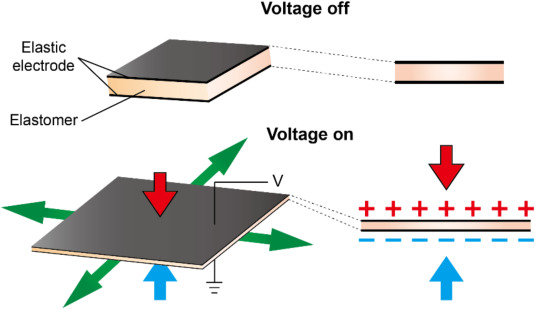
A dielectric elastomer actuator is a soft capacitor that moves. A stretchy insulating film sits between two stretchy electrodes. Apply a few kilovolts and the electrodes squeeze the film, which thins out and bulges sideways to produce muscle-like movement.
Why anyone bothers with rubber and kilovolts:
- No motors, no gears. The material itself is the mechanism.
- Silent and fast. The only moving part is the film, so it runs nearly silent. Devices respond in milliseconds, faster than a muscle twitch and far faster than pneumatics can cycle.
- Muscle-like. Good films work at 35 to 40% strain, the top of real muscle’s range. They store several times more actuation energy per gram. Biology fires on a fraction of a volt and lets chemistry do the work. We make the voltage do everything. Evolution is still winning, for now.
- Shrinks without penalty. Energy density here is a material property that does not depend on size. Shrink an electric motor and its output drops. Shrink a polymer film and nothing changes. Thin, flat, rolled, or stacked, the actuator takes whatever shape the robot needs.
The physics
Opposite charges across the film pull the electrodes together. Matching charges along each electrode push it sideways. The two add into one squeezing pressure called the Maxwell stress:
Permittivity times the square of the electric field. Permittivity is how readily the rubber stores charge. V is the voltage across the film and t is its thickness. Because the elastomer is nearly incompressible, whatever leaves the thickness has to show up as area. Pelrine et al. showed what this could do in 2000 with area strains past 100% on prestrained films. Everything on the reading list below descends from this initial paper.
That squared term sets two design rules:
- The elastomer film has to be thin, around 25 microns. Field is voltage over thickness, so a few kilovolts across that film becomes an enormous field. Coating quality decides everything.
- Breakdown ends the experiment. One dust speck or thickness ripple concentrates the field into a short circuit. After that the device is scrap.
What I did
- Fabricated 100+ DEAs by slide and spin coating elastomer films. The count is the point because breakdown is statistical.
- Screened five geometries so far for electrode shapes that peel closed progressively, a motion called zipping.
- Built COMSOL models to screen geometries and materials for the new design.
Current devices move gram-scale payloads through centimeter-scale strokes. For comparison, a standard flat-film DEA moves about a millimeter. The new design closes that gap.
Where it stands
- Devices built, measured, and matched to the COMSOL model
- Further testing and publication in progress
- Full write-up with the design, photos, and video
The reading list
The current work builds on prior DEA research. Six papers cover most of it:
- High-speed electrically actuated elastomers, Pelrine et al., Science, 2000. The founding paper. Rubber, electrodes, and strain past 100%.
- HASEL actuators (hydraulically amplified self-healing electrostatic actuators), Acome et al., Science, 2018. Puts liquid dielectric inside the actuator so a breakdown self-heals instead of killing the device.
- Peano-HASEL actuators, Kellaris et al., Science Robotics, 2018. The variant that contracts linearly on activation, like an actual muscle fiber.
- Electro-ribbon actuators, Taghavi et al., Science Robotics, 2018. Electrostatic zipping, folded into origami robots.
- HASEL artificial muscles review, Rothemund et al., Advanced Materials, 2021. Collects the whole HASEL family in one place, with the tradeoffs of each.
- Stretchable pumps for soft machines, Cacucciolo et al., Nature, 2019. A pump with no moving solid parts. The electric field drags the liquid along directly.
If six papers take too long to read, this short video shows the principle actually moving.